The Intelligent Edge by Helen Brown

Archive for 2011


Finally! A journalist GETS prospect research

3 COMMENTS

Posted by:

Every half year or so, some newspaper or magazine comes out with an article about how creepy prospect research is (last spring’s example: the Wall Street Journal in a May blog post by Anne Kadet called “Is your favorite charity spying on you?”) (and no, I’m not going to do them the favor of linking to it here).

Usually articles like these run the third rail of incendiary hyperbole along the lines of how we fundraising researchers are just one half-step up from digging through ordinary peoples’ trash to find their pay check stubs so that our conniving fundraising overlords can trick them into donating their hard-earned cash to our undeserving and overhead-bloated nonprofits.

Okay, maybe I’m going slightly overboard, but it gives you the idea of how offensive these articles are to me and my colleagues, most of whom are diligently, honestly and ethically trying to help our nonprofits help people.  Or animals. Or the environment.  Or whatever else needs taking care of.  It’s a long laundry list.  And to have a journalist from a respectable rag freaking people out to sell a couple of extra papers is insulting. I get it, the paper business is hard these days – but go pick on someone your own size.  Like politicians.

So when I saw the headline for last Friday’s New York Times article by Ron Lieber called “What Nonprofit Groups Know About You” paired with an article called “Taking Fund-Raising To a New Level,” I groaned out loud and thought “oh for pete’s sake, here we go again.”

But what do you know – I was pleasantly surprised.  As I read through, I noticed that Lieber did his homework.  He actually interviewed people – not something usually done in these types of exposes. And as I got further down, I realized it actually wasn’t an expose – it was a real education piece.  I sat there reading it, tensed in my office chair, waiting for the cringe that …never happened.

Granted, the article relies just a teeeensy bit too heavily on fundraising software megagiant Blackbaud as a source but the two consultants he quoted, Lawrence Henze and David Lamb, were two good representatives from our industry for Lieber to talk with.  Both are well-respected and Lamb is a former prospect research practitioner.

Commentary from a couple of experienced prospect researchers in the trenches currently would have been nice: I’m sure our professional group APRA (the Association of Professional Researchers for Advancement) would have been happy to steer an enterprising journalist toward a pithy prospect research professional.

But, on the whole I was …well, I was going to say “impressed” or “pleased” but to be honest “relieved” is what I mostly felt (– isn’t that kind of sad?)  Lieber actually bothered to find out what sources we use and how and why we use them.  His article was even-keeled and informative to the point of telling people how to stay under the prospect research radar if they want to.  And fair enough – everybody should have that option.

But philanthropy isn’t a game of cat-and-mouse.  At least, it isn’t for most professional prospect researchers and fundraisers I know.  The point is that we want to efficiently find prospective donors that want us to find them ~ and that want to work with us to (efficiently) change the world for the better.  Lieber’s article gets us one step closer to helping people understand that, and for that he gets my thanks and this blog post.

Tags: , , ,

You’ve Got A Secret…

0 COMMENTS

Posted by:

So let’s say you want to email a password-protected document to someone.  Or give them access to the back end of your website.  You need to send them the password to open it …but what if they’re half a world away, sound asleep?  Or they’re in a meeting, or just unavailable to take your phone call?  Emailing the word itself just isn’t a secure option, even if you are using your super duper top-secret spy subject-line code:

Trust me, the bad guys are going to figure it out – if they want to hack the document or your website, that would be the first email they’d look at.  And this is the second:

So here’s what you do:

Use a secret sharer.

One Time Secret

One Time Secret does just that – it allows you to share a secret just once.  It can be a word or a phrase that you want, or the site will generate a random password for you.  Just type in the word or phrase, click “Create A Secret Link” and an encrypted link is generated that you can cut and paste into an email.  You can set the period of time for the secret to expire – so when your secret is opened by your authorized person, it automatically disappears and can’t be accessed again.  Likewise, if it doesn’t get accessed within the allotted time, poof – it’s erased.

QuickForget

QuickForget does all the same things that One Time Secret does, but your secret doesn’t have to disappear after the first viewing.  So if you need to send the secret to more than one person, you can choose the number of ‘views’ the secret has as well as the number of hours it’s available for viewing.  There’s a handy email-it feature, too… (*cough*) as long as you don’t go with their suggested subject line…


Tags: , , ,

Helen’s interview with Mark Schaefer

2 COMMENTS

Posted by:

He may be a marketing guru now, but Mark Schaefer’s background in journalism became clear to me a couple of weeks ago.

Despite the sudden blowout of power in the restaurant we were in and the three fire trucks that raced up outside shortly thereafter with alarms bwomping and red lights circling, Mark ran out to his car to get his video camera.  I say despite those thing because he wasn’t planning on shooting the smoke coming out of the bank across the street or the firefighters trying to figure out where the exploded power line was; he was listening to me getting animated about how – if you’re not careful – Google and other search engines decide for you what you want to see when you search.  And that’s what he wanted to film!

So despite all the hullaballoo, Mark started asking me questions that he thought the members of his loyal blog community might be interested to hear more about.  It’s a short video interview that Mark posted on his blog this morning – I hope you find it worth getting excited about too!

Tags: , ,

Meaty Take-aways

0 COMMENTS

Posted by:

Next Wednesday, November 30th I’m going to be speaking at a conference sponsored by the Massachusetts chapter of the Association of Fundraising Professionals.

I mention this because it got me to thinking about what I like and don’t like about conferences. I like really meaty sessions at conferences, and I get disappointed when speakers are entirely theoretical or philosophical. I do like the theory and I do like understanding the context, but then I want you to show me how. Or at least give me a roadmap, inundate me with URLs, show me some first steps so I can figure out the rest.

It drives me crazy when the subtext of a session is if you want the real details, you’re going to have to buy my book / hire me to consult for you / buy my product.

Ugh. People come to a session to learn something, and to have practical take-aways that they can use when they get back to the office. Or at least that’s true for me.

So that’s what my seminars are – heavy on the take-aways. Sure, I’ve got a couple of the requisite cartoons and polls to get people chuckling, talking, and sharing. A lot of people in my sessions have cool tools and sites to share that I end up checking out when I get back to my office. Prospect research is like that: new tools are popping up every day, and we do love to share them! I think that’s what conference sessions should be about, too.

My session, Using the Web to Manage Information Overload is going to highlight handy web-based resources that will help fundraisers save time and get to the information they need more quickly. Prospect researchers are welcome too – come bring your best tools to manage information overload and be prepared to share and to take away.

Selected meaty take-aways if you can’t make it to the session:

A terrific research metasite from Northwestern’s prospect research department
Another one from Supporting Advancement
Prospect research Tweeters to follow

Tags: , , , ,

We’re writing a book!

6 COMMENTS

Posted by:

Jen Filla of Aspire Research Group and I have just signed a deal with John Wiley & Sons to write Prospect Research for Fundraisers; The Essential Handbook. We’re thrilled!

This book is going to be handy for every single front-line development officer, from the solo fundraiser in a one-person shop to the VP for Advancement overseeing a large university research department.

We’re going to highlight the successful partnerships, the innovative ground-breakers and the hair-tearing learning experiences, and our findings just may surprise you.

If you’ve ever wondered…

…then this book is for you!

We’re interviewing fundraisers and researchers to gain lots of perspectives, and the book will be chock-full of case studies and examples. We still have some space, so if you’d like to be featured for your great front-line/research collaborations, let us know!

Tags: , ,

More, Ben Franklin and Prospect Research

1 COMMENTS

Posted by:

The creative fundraising folks at More Partnership in the UK recently put together a small book called More stories, which is the “first in a series of little books about fundraising.”  I hope they put out another little book soon because its 32 pages delighted and entertained me with inspiring and amusing stories on fundraising (just wait ‘til you read the one about the doctor, the lawyer and the development director at the Pearly Gates!).

One of the quotes in the book really hit home for me because it dovetailed nicely with a conversation I’d just had earlier this week…

The executive director of a nonprofit in New York City and I were meeting over coffee.  She asked me how we go about finding board, volunteer and major giving prospects, and I outlined the concentric circles we study:

Starting with those closest to the organization (trustees, lead volunteers, etc.) we work our way outward through their branches of connection, so that the people, foundations and companies we identify already have a clear connection to the organization or to the cause they serve.  We eliminate those who have been previously involved or were asked to serve but could not.  We build a model of the ideal prospect, and see what obvious connections can be branched from there.  And, of course, we do a few other trade-secret-y things.

Our process is hand-tailored and intense because we believe that one warm call that will be answered is much easier for a fundraiser to make than 15 cold calls.  And if it can’t be a warm call, then we suggest one where the potential attraction is so obvious that it has the power to lean the prospect like a magnet toward the new cause.

Reading this quote from Ben Franklin, I was struck by the thought that, even 220 years later, the important things stay the same.


Tags: , , ,

Will SIBs cannibalize philanthropic giving?

0 COMMENTS

Posted by:

Discussion about Social Impact Bonds is really hot right now.  SIBs have the ability to reward nonprofits for being innovative and for achieving measurable and replicable success.  But will they remove funding that would have been philanthropically given?  And will smaller nonprofits be left out in the cold?

To find out more, I attended last week’s Social Innovation Forum hosted by Root Cause.  The featured speaker was Jeffrey Liebman, Malcolm Wiener Professor of Public Policy at the Harvard Kennedy School of Government.  After Liebman’s opening remarks, a panel of experts discussed SIBs and how they might affect nonprofits.

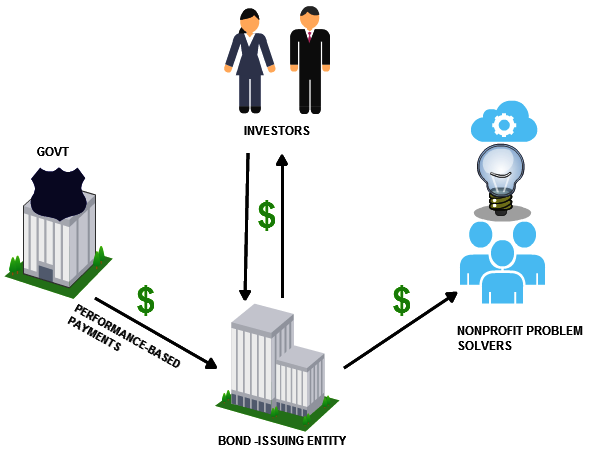
Liebman provided a very simple graph to illustrate the flow of money in a SIB, which looked something like this:

Here’s how it works in a nutshell:  A nonprofit (or more probably, a collaboration of nonprofits) works with a bond-issuing entity to raise funds to solve a social problem.  Investors are approached by the bond-issuing entity and the investors provide working capital to the bond-issuer.  Investors are guaranteed a rate of return if the project succeeds, and the return on investment is likely gauged to the project’s risk of success.  (If the project fails, investors lose their money).  When the project is completed and has met performance targets, the government pays the bond-issuing entity, which pays back the investors their initial investment plus interest.

It’s a win-win-win.

  1. The problems solved are ones the government would have funded anyway (reduced recidivism, for example, or after-school reading programs).  But with SIBs, the government only pays when there is demonstrated success, lessening government waste.
  2. Venture philanthropists and foundation leaders have a creative tool for their investment portfolio to both fund programs and reap a return on their philanthropic investments which they can then use to seed another venture.
  3. Nonprofits with proven success in their field of expertise have another pool of potential support to draw from.

Jeffrey Liebman calls SIBs a “Pay-For-Success” program, and it’s easy to see why.  As he explained, SIBs improve nonprofit performance and lower cost to the government; they accelerate the adoption of new solutions that are broadly replicable; and there is more rapid learning of what works and what doesn’t.

So what are the problems with a Pay-For-Success program?

Well, there are a lot of nonprofits out there and competition for dollars is already fierce.  According to the National Center for Charitable Statistics, over 1.6 million charities registered with the US IRS in 2011. Granted, about 100,000 are foundations and a little over 500,000 are professional associations, fraternal organizations, chambers of commerce, etc.  Still, that leaves about a million nonprofits vying for philanthropic support and not all of them will be candidates to participate.  Also, SIBs won’t work for every type of nonprofit.

The likely participants will be collaborations of nonprofits working together to creatively solve a specific social problem.  They will provide new solutions with the potential for high net benefits and will be able to provide measurable outcomes.  The populations they serve will be well-defined and there will be a reliable comparison group.

Won’t this mean dollars formerly allocated to philanthropy will be used for SIBs?

Panelist Tracy Palandjian of Social Finance Inc. commented that SIBs wouldn’t cannibalize philanthropic dollars because a foundation could invest in SIBs from the 95% of their investment corpus rather than from their 5% annual distribution.  SIBs become both another investment vehicle and a way to further a foundation’s vision and mission.

One forum participant, a representative of a foundation observed “isn’t it the point to cannibalize money from underperforming nonprofits to fund those that are producing results?”

What is clear is that all nonprofits – those struggling for money merely to survive as well as those that are well-established – will need to start measuring their impact on the communities they serve if they aren’t already.  Today’s donors already expect to see a nonprofit’s results clearly outlined but a social impact bond-holder will require it, and it will be the bond-issuer’s job to track the venture’s success.  Will there be a move within our industry to set standards for the metrics that are tracked?

As a professional in this field, the idea that we researchers will be helping our organizations create the most logical metrics and use that data to improve service delivery is exciting to me.  But as cool as that is, and even though there is already one test-tube SIB in place in the UK, I can’t get too excited yet.

The biggest roadblock?

The biggest problem could be politics.  Most projects that a SIB would cover would likely be funded over one or more election cycles.  What happens if the next person in office decides that they don’t want to honor the previous office-holder’s bond agreement?

In an era where Congress can’t seem to get it together over the simple task of running its daily business, what chance does a new initiative – however fiscally sound, however cost-saving – have?

Governor Deval Patrick of my home state of Massachusetts was the first to formally seek to explore SIBs in May of this year.  We’ll see if he leads us to create the first one in the US.

RootCause wisely videotaped some of the key segments of this fascinating forum.  Have a look to learn more!

Read more here about Social Impact Bonds and Impact Investing (which apparently goes back to the Civil War!) from the Harvard Business Review’s blog article written by Chris Meyer and Julie Kirby.

Tags: , , , , , ,

HBG grows!

2 COMMENTS

Posted by:

Last week I had the pleasure of welcoming two new colleagues into the Helen Brown Group.  The fundraising world being as small as it is, you never know when you’re going to have the opportunity to work with someone again, and it’s certainly true for me with both Andrea Marks and Maureen Kilcommins.

Andrea Marks

Andrea Marks

I first worked with Andrea Marks ten years ago at Northeastern University when she was just starting out in prospect research.  Bilingual and a cum laude graduate of Boston University in international relations, Andrea was quick to understand the value of research in fundraising and its global possibilities.  Soon graduate school called her, and after receiving an MBA degree specializing in international business and marketing, Andrea worked for three multi-nationals and an NGO managing their payrolls.  I’m delighted that we were able to entice Andrea back into prospect research, and happy to have her international research and language skills.

Maureen Kilcommins

Maureen Kilcommins

Maureen Kilcommins and I have worked together for the last ten years in support of the North American Foundation for the University of Manchester (NAFUM), England.  Previously Maureen worked as director of prospect research and management for Bentley University and as director of annual and special gifts for UC-Santa Cruz and associate director of the Harvard Law School Fund.  Maureen’s experience in research, front-line fundraising and operations brings a triumvirate of value for our clients looking for advice in those areas.  Maureen will continue in her role as North American administrator for both NAFUM and Sightsavers and will work with HBG on a part-time basis.

Welcome Andrea and Maureen!

Tags: , , , ,

17 questions to ask before hiring a research consultant

4 COMMENTS

Posted by:

The Showcase of Fundraising Innovation and Inspiration (SOFII) has curated a group of great articles on how to be an effective partner with consultants in our sector.  As a riff on Alison McCants’ great web article sharing her experience, I thought I’d add some questions to ask before engaging a research consultant:

  1. What resources do you use?
  2. Do you purchase them yourself?
  3. How often do you attend continuing education courses to keep up with the latest resources and trends?
  4. Do you teach any training courses?
  5. What types of organizations have you worked for?
  6. What kinds of reports do you provide?
  7. How much do they cost?
  8. May I see samples of your work?
  9. How long does it usually take for you to complete a report?
  10. May I speak with three current/recent clients?
  11. What is your privacy/confidentiality policy? (Thanks to Jen Filla for that one!)

Ask a consultant’s references:

  1. How easy is this consultant to work with?
  2. Do they provide good customer service when something goes wrong?
  3. Do they deliver research when promised?
  4. How do you feel about the quality of what you receive?
  5. Is their work good value for the price?
  6. Are they innovative?

Do you have more questions to add?

Tags: , , , ,

Summer reading: wealth and philanthropy

0 COMMENTS

Posted by:

With the publication of the always-worth-reading “World Wealth Report” last week, it reminded me that I wanted to mention to you a few white papers about high net worth individuals (HNWIs) that are well worth your time.  They are:

The World Wealth Report 2011.  CapGemini / Merrill Lynch.

  • FREE with registration.
  • Brief overview with additional links here; actual report in English here.
  • The WWR details high net worth individuals worldwide: where they live, what they spend their money on, how they allocate their assets, etc. and they break the information down by country or region to achieve even more granularity.  A tidbit I found interesting in this report: women made up 27% of the global HNW population in 2010, up from 24% in 2008.  From under a quarter to nearly a third in two years – what does that make you think about your prospect portfolios?

The Wealth Report: A Global Perspective on Prime Property and Wealth 2011. Knight Frank / Citi Private Bank.

  • Pdf version is FREE, click here.  Hard copy also available with registration.
  • For researchers and front-line fundraisers specializing in international work, this is a must-read overview of already-hot and emerging high-growth regions, industries, and people with a focus on global wealth and real estate.  Contains interviews with experts such as Rupert Hoogewerf of the Hurun Rich List and discussions of topics including venture philanthropy.


Bank of America Merrill Lynch High Net Worth Philanthropy Study 2010.  In collaboration with Indiana University Center on Philanthropy.  Biennial.

  • Pdf version is FREE, click here.
  • The study is a survey of HNWIs to discover their attitudes toward giving and philanthropic behavior, how they make philanthropic decisions within their household, and their thoughts on volunteering and engagement.  In addition to the study, there is also a video at the site featuring a panel discussion with two members of the Bank of America team and the director of research from the IU Center on Philanthropy.

Not specifically about HNWIs, but certainly related is:

Giving USA 2011. The Giving USA Foundation / Indiana University Center on Philanthropy

  • Hard copy; web-based version; powerpoint slides and pdfs; $75
  • Subscribers can (at the moment) access Volume One: the Numbers.  Full publication to be released in July.
  • Giving USA provides preliminary statistics on giving within the United States.  The resource comes as a hard-copy book or web-based version, and includes tons of charts, graphs, and statistics as well as information on historical giving and trends.

Lastly, and maybe most fun:

For an engaging, entertaining, and enlightening article that gives you a glimpse into what it’s really like to be ultra wealthy, read this some Friday afternoon at 3 when you still need to work but just can’t make your brain do anything.  From The Atlantic magazine, the article is called “The Rise of the New Global Elite.”

Do you have any other must-read white papers to share?

Tags: , , , , , ,