By: Maura Baron, Senior Consultant
Part 2: Building the System: Pipeline, Portfolios, and the Metrics That Drive Accountability

Maura Monley Baron
In the first part of this series, we explored what prospect management is and why it matters for prospect researchers seeking to play a strategic role in their organizations. In Part 2 of this blog, we will get into the mechanics: how the cultivation pipeline works, how portfolios are built and prioritized, and how the right metrics and meeting structures keep prospects moving forward.
*A special thank-you to my colleague Tara McMullen-King, whose original prospect management training document, developed for an HBG team meeting, provided the foundation for this series.
The Pipeline: Where Data Becomes Movement
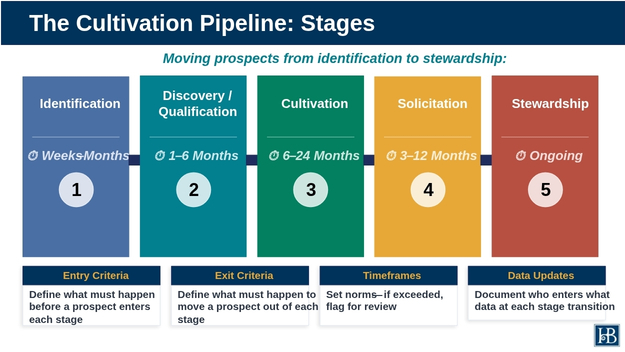
The cultivation pipeline is the backbone of prospect management. It maps the journey a donor takes from initial identification through qualification, cultivation, solicitation, and stewardship.
What makes a pipeline effective is not simply the existence of stages. It is the discipline built around transitions: clear entry criteria defining what must be true before a prospect moves into a new stage; exit criteria specifying what must be accomplished to advance; documented expectations about who updates which data at each transition point; and timing norms that flag when a prospect has been in a stage longer than expected.
The Ratings That Make Prioritization Possible
At the center of any effective prospect management system is a set of ratings that help teams answer the hardest practical question in fundraising: Who should we focus on right now?
Four ratings do the most strategic work:
- Capacity: What can they give? Defines the best possible gift a prospect could make if they chose to give at their highest level. It is typically expressed in monetary ranges and informed by wealth screenings, research, and gift officer observations.
- Inclination: Do they want to give? Assesses how aligned a prospect is with the organization’s mission, separating those who could give from those who are likely to give.
- Readiness: Is this the right time to give? Asks whether the timing is right for a gift conversation because high capacity and strong inclination do not automatically mean a prospect is a current priority.
- Engagement: How connected are they? Measures how actively connected a prospect is to the organization at the present time.
These four ratings work together. High capacity paired with high inclination and strong readiness signals a prospect to prioritize immediately. High capacity with low inclination suggests a longer-term cultivation investment.
For example, a donor who owns a successful business and regularly attends your organization’s cultivation events may have high capacity and high engagement. However, if the donor has recently shared that they are buying a family member out of the business, their readiness may be low, making them a continued cultivation priority rather than an immediate solicitation opportunity.
By contrast, a recently retired alumnus with moderate capacity, growing engagement, and an active estate-planning process may represent the more immediate opportunity.
The Daily Mechanics of Prospect Management
Day-to-day activity within the pipeline is captured through three main mechanisms:
- Moves: Strategic activities that advance a prospect’s commitment toward a gift.
- Actions: Specific tasks that support cultivation.
- Contact reports: Written records of substantive interactions that preserve institutional knowledge of the relationship.
The next question is: What is this activity leading to? This is where the focus shifts from activity to outcomes.
Proposals, gifts, and stewardship track progress through the giving cycle: from making the ask to securing the gift, to continuing and growing the relationship over time. This connects activity to actual results and helps teams forecast what may come next.
Prospect work plans take the process a step further by making strategy explicit: what you are trying to accomplish with each prospect, what needs to happen next, who is responsible, and when. This is also where alignment between research and frontline fundraisers becomes especially important. Instead of simply tracking what has happened, teams are actively planning what comes next.
Together, these elements ensure that activity leads somewhere, progress is measurable, and strategy is intentional.
From Activity to Action
Stages help define where someone is in the fundraising process. Activity tracking—through moves, actions, and contact reports—captures what is happening along the way.
But this is where things can often break down. Organizations may become very good at recording activity without necessarily using that information to guide what happens next. The result can be a lot of data about what has been done, but not much clarity about what should happen next.
That is where planning tools, such as work plans and proposals, become important. They shift the focus from “What did we do?” to “What are we doing next?”
Data should answer the question, “What happens next?” If it does not, it is not doing its job.
Building Blocks
The number of fields, codes, and data points in a prospect management system can feel overwhelming. Not all of them, however, serve the same purpose. Think about them in three groups:
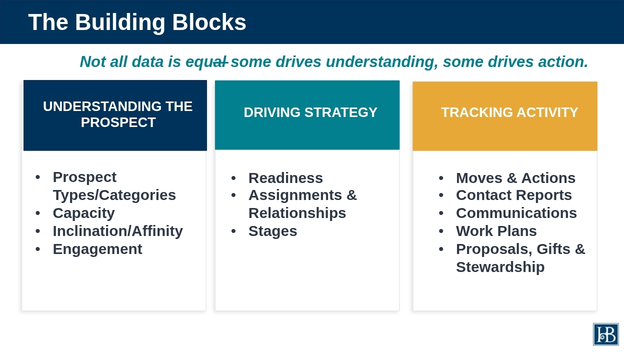
All three are important, but they do not carry the same weight when it comes to decision-making. The key is to build a system that includes all three while prioritizing the information that drives action.
Portfolios: Size, Composition, and Prioritization
Gift officers are not managing one prospect. They are managing dozens simultaneously. Portfolio management is the discipline of deciding who belongs in that group, how large it should be, and where attention should be concentrated.
Portfolio size varies significantly by role, gift complexity, and organizational model. As a starting point, some organizations suggest 20 to 50 prospects for senior executives or principal gift officers and 100 to 150 prospects for major gift officers.
Beyond size, portfolio composition matters. A healthy portfolio is not a list of similar prospects at the same stage. Portfolio composition will differ by campaign phase, organizational size, donor base, and portfolio maturity. However, it should include a deliberate mix of prospects at different stages. For example, an organization might aim for 30 to 60 percent of a portfolio in cultivation, 20 to 30 percent approaching or in solicitation, and the remainder in qualification or stewardship.
Prioritization within a portfolio is where ratings do their most practical work. Prospects with high capacity and high inclination should be prioritized immediately because they represent the best major-gift opportunities. High capacity with low inclination signals a longer-term cultivation investment. Strong inclination with more modest capacity is still worth managing, but the strategy and ask level will look different.
Applying this logic systematically across all gift officers, using shared definitions, is what turns a portfolio from a list into a strategic plan.
Metrics and Meetings That Create Accountability
A prospect management system is only as valuable as the behavior it produces. The final layer is measurement and the meeting structures that make the data meaningful.
Common key performance indicators include the number of substantive contacts made, unique visits conducted, days a prospect spends in each pipeline stage, solicitations submitted, proposals closed, and new prospects qualified. These metrics do not just measure activity. They tell a story about where momentum exists, where progress is stalling, and whether the portfolio is positioned to meet fundraising goals.
Three types of structured meetings make data actionable:
- Monthly data optimization meetings focus on data quality by auditing portfolios for inaccuracies, filling gaps, and maintaining the reliability that makes the system trustworthy.
- Portfolio strategy meetings, held two to four times per year, zoom out to align gift officer priorities with organizational goals and right-size portfolios as circumstances change.
- Prospect strategy meetings, held one to four times per month, are where real-time decisions happen: reviewing specific prospects, refining cultivation strategy, and determining next steps. Ideally, these meetings include research staff and take place with the CRM open.
These meetings are where data becomes decisions and where prospect management becomes visible. This is where data is used in real conversations, decisions are made based on that information, and research directly shapes fundraising strategy. This is where prospect development moves beyond a support function and becomes a true strategic partner in fundraising.
The Strategic Role of Research
When research and prospect management work together, research directly informs ratings, portfolio priorities, and prospect strategy. Researchers help shape data standards, provide real-time pipeline intelligence, and ensure that information leads to action.
Without prospect management, valuable research can be underused, priorities may be unclear, and the work can become reactive. With it, research drives ratings, portfolios, and prospect plans. It also supports clearer decisions, stronger team alignment, and a shared language across fundraising.
This shifts prospect development from providing information to shaping strategy: from reactive support to a visible, valued partner in fundraising success.
Practical Takeaways: Get Started at Your Organization
- Audit your current system. Identify what is tracked, what is missing, which codes are inconsistent, and which reports you wish you had.
- Develop a glossary. Define every term and code your team uses. If different people define “cultivation” differently, your data will not be dependable.
- Invite gift officers into the process. Build the system with them, not for them. They are more likely to use a system they helped create.
- Connect research to reporting. Identify reports that make the impact of research visible, including pipeline forecasting, alignment between capacity ratings and ask amounts, portfolio health, and activity.
- Become a system resource. Understand policies and pipeline stages deeply. Be the person who helps gift officers understand what should happen next and how all the pieces fit together.
- Start small and build over time. You do not have to implement everything at once. Launch, learn, improve, and document as you go.
Research becomes strategic when it helps teams make better decisions, coordinate next steps, and measure progress toward fundraising goals. That is when prospect development moves from supporting fundraising to helping shape its direction.